What is PlayToBurn?
PlayToBurn is a browser-based gaming platform built around a simple idea: play free games and help reduce the PTB token supply.
Gameplay itself does not pay PTB or SOL rewards. Verified gameplay generates Burn Units that determine how much PTB is scheduled for burning from the active burn pool. SOL holder rewards are a separate feature of the PTB reward-token model.
From gameplay to burn
01
Play
Play free browser games.
↓→
02
Burn Units
Verified gameplay generates Burn Units.
↓→
03
Pending Burn
Burn Units × the current burn rate determine the scheduled burn.
↓→
04
On-Chain Burn
Only a confirmed blockchain transaction counts as burned.
How the Burn Works
The first active PTB burn pool is funded by the project. Verified gameplay generates burn obligations against this pool.
One Snake food pickup generates one Burn Unit. In Minesweeper, twelve safely revealed fields generate one Burn Unit. Additional games can use their own transparent Burn Unit rules.
The resulting PTB amount is first recorded as Pending Burn. Pending amounts are grouped for settlement. They only count as burned after the corresponding Solana transaction has been confirmed.
Dynamic Burn Rate
The burn rate automatically adapts to verified player activity, the available burn-pool balance and the remaining time in the current burn phase.
When activity is very high, the rate can decrease so that the pool is not exhausted too early. When activity is lower, the rate can increase again. The controller operates within predefined minimum and maximum values.
The purpose of the controller is not to move the target date. The target date remains fixed. The burn rate manages the available pool toward that target in a controlled way.
First Burn Phase
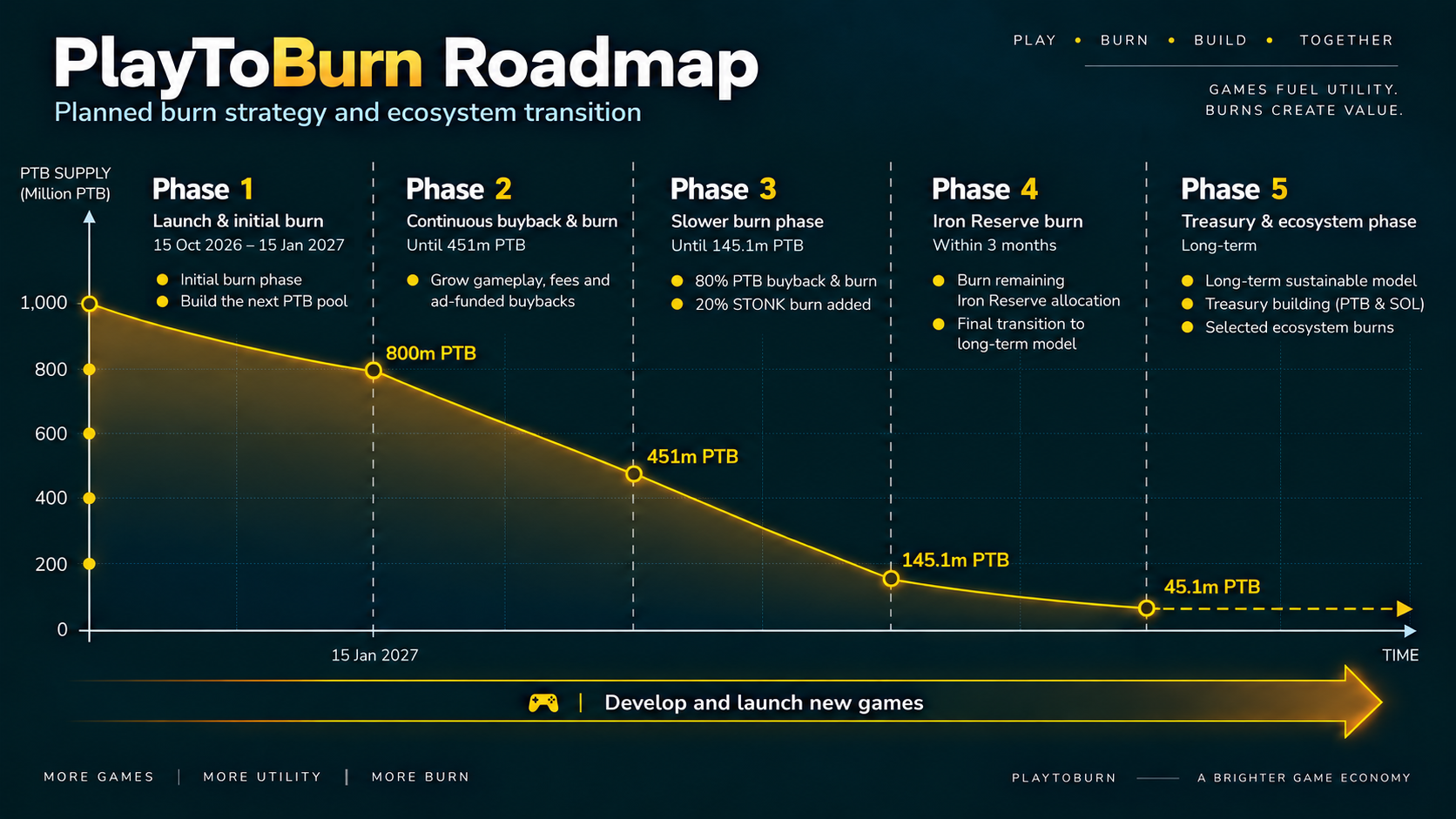
The first burn phase is planned from 15 October 2026 until 15 January 2027. The initial active burn pool is planned at approximately 200 million PTB.
The objective is to burn the active pool almost completely during this period. Only a very small residual balance is intended to remain as an operational safety margin.
A separate Refill Pool is built in parallel. Later burn phases can switch to their designated source pool without requiring unnecessary PTB transfers between project wallets.
Planned Launch Structure
PTB has a fixed supply of 1 billion tokens. No Dev Buy is planned. After launch, the project intends to make an immediate regular market purchase targeting more than 300 million PTB. The exact amount cannot be predetermined because the final received balance depends on the live market purchase and the reward-token transfer fee.
| Allocation | Planned Amount | Purpose |
|---|
| Start Burn Pool | ≈ 200M PTB | Active burn pool for Phase 1 |
| Refill Pool | Remaining launch allocation + future buybacks | Burn-pool funding for Phases 2 and 3 |
| Iron Reserve | 100M PTB | Reserved for Phase 4 |
The figures are target allocations. Actual received balances are verified on-chain after launch before the burn system is activated.
3% Transfer Fee & SOL Holder Rewards
PTB uses the reward-token model. A 3% transfer fee applies to PTB transfers, including buys, sells and wallet-to-wallet transfers.
The reward mechanism collects the transfer fee in PTB, converts the reward pot into the pair asset and distributes rewards proportionally to eligible PTB holders. PTB is paired with SOL, so the holder reward asset is SOL.
Gameplay and holder rewards are separate mechanisms: playing generates PTB burns, while holding eligible PTB can generate SOL rewards.
SOL also has direct utility inside the Solana ecosystem. It is Solana's native asset and is required to pay network transaction fees, so even small SOL rewards can contribute to the balance a wallet needs for everyday transactions. SOL can also be staked and may generate additional staking rewards.
Transfer Fee
3%
PTB transfers
Holder Rewards
SOL
Distributed in SOL
Illustrative 100,000 PTB transfer
PTB transferred
100,000 PTB
This simplified example illustrates the 3% transfer fee. Exact reward distribution timing, eligibility rules and any platform-level distribution adjustments follow the live reward-system configuration and will be published transparently at launch.
Advertising brings outside capital into the system
100% of PlayToBurn's net advertising revenue is reinvested into PTB buybacks and added to the Refill Pool.
This is a core principle of PlayToBurn: advertising brings capital from outside the PTB trading ecosystem into the token economy. This part of the burn funding therefore does not require one user's capital to provide exit liquidity for another user.
Ad breaks are scheduled at 120-second intervals, but they never interrupt an active game. If an ad becomes due during gameplay, it waits until the current round has ended.
You play. Ads pay. PTB burns.
Platform operation & verification
Public statistics are refreshed every five minutes instead of continuously. This reduces backend and database requests and helps keep operating costs under control without changing the underlying recorded data.
Some game interactions may occasionally feel slightly delayed or less smooth because important actions are verified by the server as part of PlayToBurn's anti-cheat protection. This trade-off helps ensure that Burn Units are based on verified gameplay rather than client-side manipulation.
Building the Refill Pool
While the active burn pool is reduced through gameplay, the separate Refill Pool for Phases 2 and 3 is built in parallel.
100% of PlayToBurn's net advertising revenue is reinvested into PTB buybacks for the Refill Pool. Advertising therefore provides a continuous source of external capital for future burns.
In addition, project-controlled PTB holdings can generate fee-derived SOL income through the holder-reward model. Under the initial launch model, 75% of this income is reinvested into PTB buybacks for the Refill Pool.
The remaining 25% of the fee-derived income is retained as a safety buffer for taxes, server infrastructure, operating costs and necessary business liquidity. Only the portion actually used for PTB buybacks is counted as additional Refill Pool funding.
PTB buybacks are themselves subject to the reward-token transfer fee. The actual PTB received by the Refill Wallet is therefore recorded from the real on-chain balance rather than assumed from the gross purchase amount.
When the next burn phase begins, the separately held Refill Pool can become the source pool for the burn system. PTB does not need to be transferred between project pool wallets simply to change phases.
Donations
Donations are optional and are never required to use PlayToBurn.
Donations intended for the burn mechanism are sent directly to the public Refill Wallet and become part of the Refill Pool. Donation funding is reported separately from holder rewards, advertising revenue and initial project funding.
Refill Wallet
Holds PTB accumulated for Phases 2 and 3. Voluntary donations intended for the burn mechanism are also sent directly to this wallet.
8Td97BYWxTxPnZynS4xU4TsdnCKzrrDbPdJp79FZfkyW
Public Wallets & On-Chain Verification
PlayToBurn uses separate public wallets so that the different parts of the burn architecture can be independently tracked on-chain.
The Refill Wallet holds PTB accumulated for Phases 2 and 3, including PTB purchased with advertising revenue, the reinvested portion of fee-derived income and voluntary burn donations.
The Iron Reserve Wallet is kept separately and contains the long-term PTB reserve intended for Phase 4.
PlayToBurn clearly distinguishes between Pending Burn generated by the platform and PTB that has actually been burned on-chain. Confirmed burn transactions are published with their transaction signature.
Public Project Wallet
Public project and treasury wallet used for transparent project transactions.
7TiTHr8JhUxVN2QBdbnQb7Rkb1qJjErxoVv3s5rSfsQh
Refill Wallet
Holds PTB accumulated for Phases 2 and 3. Voluntary donations intended for the burn mechanism are also sent directly to this wallet.
8Td97BYWxTxPnZynS4xU4TsdnCKzrrDbPdJp79FZfkyW
Iron Reserve Wallet
Separate long-term reserve wallet containing the PTB allocation intended for Phase 4.
5HBeYb3G7ZFL5wSaQNWXFFK3aLaqudYq51cYgHs6AHmK
Transparency
Don't trust the counter. Verify the burn.